Vehicle lockout tools (air wedges, protective wedges, long-reach tools and specialty picks) are professional equipment for trained, authorized technicians. If you’re locked out of your car, use an authorized spare or call roadside assistance or a locksmith; don’t try to force the door.
Do I Really Need a Locksmith? · Bill’s DIY series
“I can do this myself.” Do I really need a locksmith?
Verdict: Pro jobThe tools pros use on car lockouts
Get the Key Fob & Car Key Care Guide →$4.99 · instant PDF downloadInside: signs your fob is dying, battery swap basics, spare-key tips, what to do if you lose a key, and when to call a pro.
Locked out of your car right now?
- Use an authorized spare if someone you trust has one.
- Call roadside assistance if your insurance, auto club or vehicle plan includes it, or call a locksmith.
- If a person or animal is in immediate danger, call emergency services.
- Don’t force the door or glass. Airbags, wiring and fragile trim can make an apparently simple job risky.
Key fob acting up instead? Check the battery first: see 2016 Ram key fob not working.

What vehicle lockout tools are—and what they are not
Vehicle lockout tools are specialized professional equipment used by trained locksmiths and roadside technicians on an authorized service call. They are not a substitute for customer verification, insurance, vehicle-specific knowledge, careful documentation, or practical training. The correct tool category depends on the vehicle, the technician’s competence, and the safest non-destructive service option available.
This public lesson explains the categories at a high level. It intentionally does not provide a complete entry procedure, model-specific bypass sequence, or enough consecutive instruction to replace supervised automotive training. If a vehicle design, security system, or customer situation falls outside your current competence, stop and escalate the job.
Common professional tool categories
- Inflatable air wedges: Professional technicians may use an air wedge as part of a controlled access setup. Poor placement or excessive pressure can damage weatherstripping, trim, glass, wiring, or a door frame.
- Protective wedges and shields: These tools help create separation and protect painted or finished surfaces. They do not remove the need to understand the vehicle’s construction.
- Long-reach tools: Reach tools come in different shapes and lengths for trained, vehicle-appropriate applications. Interior controls, airbags, wiring, and fragile trim can make an apparently simple job risky.
- Lasso and specialty loop tools: These are limited-purpose tools whose usefulness depends heavily on the vehicle and the technician’s training.
- Automotive picks and decoders: Tools such as model-specific picks or decoders require keyway knowledge, lawful authorization, and considerably more training than a general overview can provide.
- Hooks and model-specific tools: Specialty tools solve narrow problems. A tool’s presence in a kit does not mean it is suitable for every vehicle or every technician.
Why training and authorization matter
Modern doors can contain side-curtain airbags, electrical harnesses, glass channels, sensors, laminated glass, delicate weather seals, and tightly fitted trim. A technician must consider those hazards before choosing a service approach. The safest decision is sometimes to refer the customer to an automotive specialist, roadside provider, or dealership.
Before work begins, confirm the customer’s identity and authority to access the vehicle. Record the vehicle information, document visible pre-existing damage, explain the intended service scope, and stay within local law, insurance coverage, and your current training. Locksmith Blueprint education does not grant legal authority or replace vehicle-specific technical information.
The Locksmith Blueprint Watch It / Read It / Do It system
WATCH IT
Use the video above for a quick visual introduction to several common tool categories. It is part of the lesson, not the entire training product.
READ IT
Use this written guide to understand professional boundaries, damage risks, customer authorization, tool vocabulary, and the next training path.
DO IT
Complete the pre-job decision exercise below before considering automotive work. Do not practice entry on a vehicle without authorization, suitable training, and a controlled learning environment.
Do It: build a safe pre-job decision checklist
- Write down how you will verify the customer’s identity and authority to access the vehicle.
- Identify the vehicle year, make, model, visible condition, and any known security or electrical considerations.
- Confirm that the requested work fits your insurance, local requirements, training, and documented service scope.
- Decide in advance which conditions require you to stop, decline, or refer the job to a better-equipped specialist.
- Create a simple record for authorization, pre-existing damage, service notes, and customer acknowledgment.
Where automotive work belongs in a beginner training path
Automotive lockout work is a specialty, not the best first hands-on project for every beginner. Start with lock terminology, mechanical fundamentals, tool identification, customer verification, and careful diagnostic habits. Then add supervised or structured automotive education before accepting paid vehicle work.
- Start the Beginner Locksmith Path for a logical entry sequence.
- Compare locksmith school and training routes before choosing a program.
- Review the national career roadmap and state-check process.
- Build diagnostic thinking with Common Lock Problems.
- Study responsible first paid jobs after your fundamentals are reliable.
Explore Locksmith Blueprint training products
Choose the level that matches your next step. The free page builds understanding; the paid products provide the deeper system, professional references, and implementation detail.

Foundation Edition — $39
A beginner-focused starting framework for people building their first locksmith vocabulary and training plan.
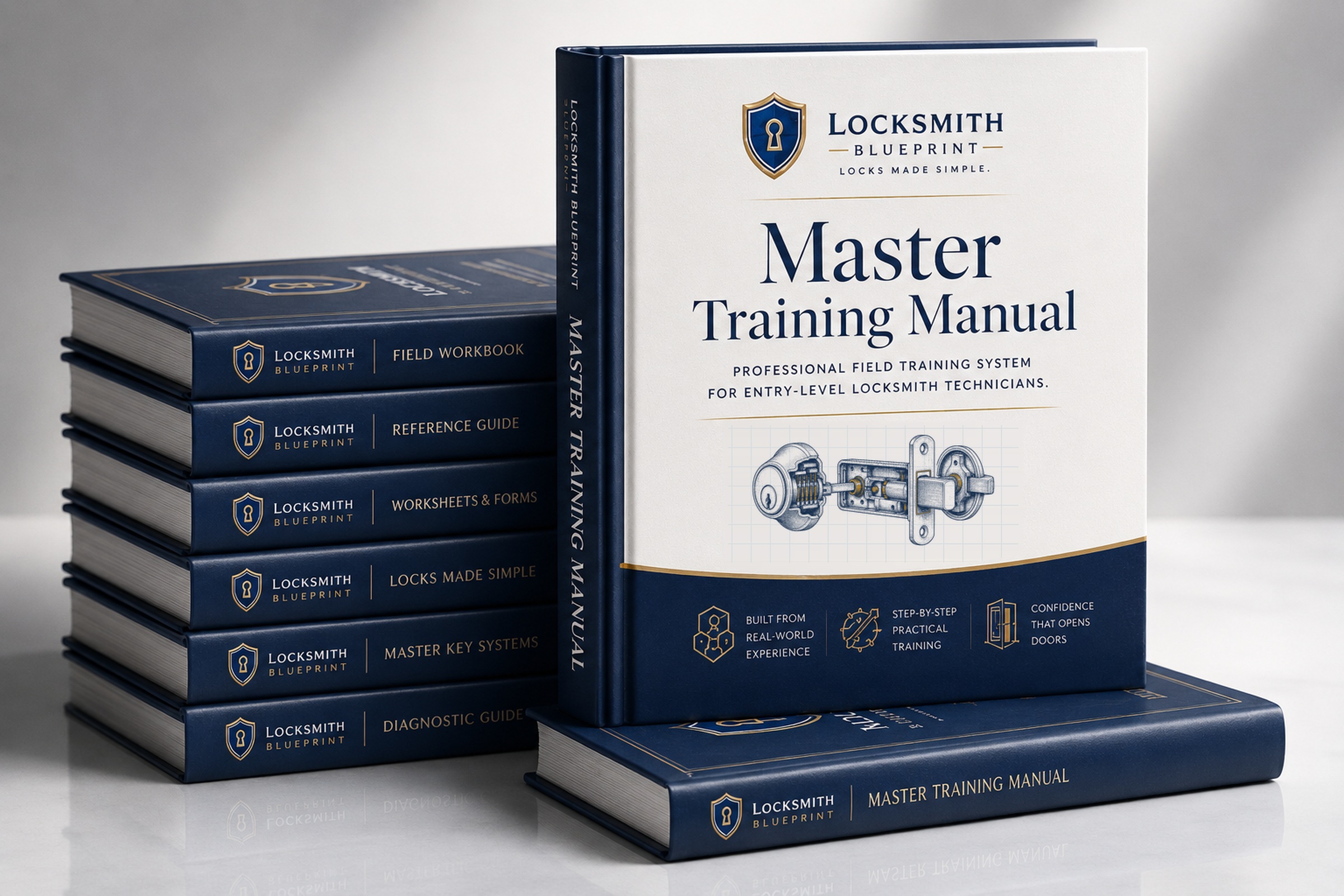
Master Training Manual — $97
The flagship structured training and field-reference system for deeper professional locksmith education.
Operator Version — $197
A business and operating-system path for technicians preparing to run a professional locksmith company.
Vehicle lockout tools: common questions
Can a beginner buy vehicle lockout tools?
Availability does not equal competence or legal authority. Before buying specialty tools, understand their legitimate purpose, local rules, insurance requirements, damage risks, and the training needed to use them responsibly.
Does one vehicle lockout kit work on every car?
No. Vehicle construction, security systems, interior controls, glass, trim, and access considerations vary. Professionals choose an authorized service approach based on the specific vehicle and stop when the job exceeds their tools or competence.
Is the short video the complete training?
No. The video provides a focused visual overview. This page adds context and decision guidance, while deeper training provides structured instruction, reference material, supervised practice, and professional workflow.
Educational and safety notice: Perform vehicle work only with verified authorization, appropriate training, suitable insurance, and compliance with current law. Do not attempt work that exceeds your competence.

Locksmith BlueprintLocks Made Simple
Real locksmith know-how from Bill, a working locksmith in Arizona: short videos, plain-English guides and printable checklists.