How to Become a Locksmith in Alaska
No statewide locksmith license identified in Alaska. Confirm construction, electrical, access-control, alarm, and local rules before offering those services.
Bill’s step-by-step locksmith business startup system.
One-time purchase via Gumroad. Study and planning aid only; official agencies set the requirements.
Alaska quick facts
Summarized from the official sources cited in this guide. Confirm with the agency before you pay or accept work.
- State license
- None identified. No locksmith-specific profession appears on the current state professional-license roster. Alaska professional licensing roster
- Exam & background
- No confirmed locksmith exam; background check and fingerprinting not identified for ordinary mechanical locksmith work.
- Business
- An Alaska business license is generally required to engage in business; construction scope can trigger contractor licensing. Alaska business licensing FAQ
- Specialty work
- Confirm construction, electrical, access-control, alarm, and local rules before offering those services. Alaska Business Licensing home
Requirements change. This is not legal advice. Full details and every source are below.

How to Become a Locksmith in Alaska
Alaska separates an ordinary mechanical-locksmith plan from the licenses attached to operating a business and altering a fixed structure. Start with the service you will actually sell, then check the business, contractor, electrical, and local layers that match that service.
What the current Alaska sources do—and do not—require
This is a scoped research result, not a universal permission slip. It addresses ordinary mechanical locksmith work first and separates specialty work that can trigger a different rule.
Statewide locksmith license
No statewide locksmith-specific license identified
Locksmith exam
No confirmed locksmith exam
Age
No statewide locksmith-specific age requirement was identified in the official sources reviewed. Employers, contracts, and specialty credentials may set separate minimums.
Background check
Not identified for ordinary mechanical locksmith work. Recheck any employer, local, alarm, security, or specialty-credential rule.
Fingerprinting
Not identified for ordinary mechanical locksmith work. Do not apply that answer to a separately regulated security or alarm role.
Training or apprenticeship
No statewide locksmith-specific training or apprenticeship mandate was identified. Structured instruction, hands-on practice, and supervised field exposure remain the safest professional path.
Business or agency license
An Alaska business license is generally required to engage in business; construction scope can trigger contractor licensing.
Insurance or bond
Insurance: Confirm with the state, locality, insurer, and contracting authority.; Bond: Not identified in current sources reviewed
Evidence status: VERIFIED – CURRENT. Official-source review: 2026-09-09. Recheck before paid work because laws, rules, agency guidance, forms, and local requirements can change.
The Alaska decision that prevents expensive mistakes
A customer wants a cylinder rekey and also asks you to replace a damaged exterior door and add powered access. Treat that as three scopes, not one locksmith call. The rekey begins as mechanical work; the door replacement can become construction; and powered access can trigger electrical or communications rules.
Work-scope boundary
Confirm construction, electrical, access-control, alarm, and local rules before offering those services.
Local layer
City, county, and scope-specific rules may apply even when no statewide locksmith credential is identified.
Safe rule
Describe the complete job to the responsible agency. Never assume a business name, training certificate, or mechanical-lock task also covers wiring, alarms, construction, or life-safety work.
An Alaska path you can follow in order
Map the Alaska service territory
List the communities you will serve, travel conditions, emergency-response limits, and whether the business will be mobile, home-based, or storefront-based.
Obtain the business authorization
Use Alaska's business-licensing guidance, choose accurate activity descriptions, and retain the issued record before advertising paid service.
Separate cylinders from construction
Write two job categories: keys, locks, and cylinders on one side; doors, frames, structural alteration, and major installation on the other.
Check powered-hardware scope
Before running cable or connecting electronic access, ask the responsible agency which electrical, communications, alarm, or contractor classification governs the complete job.
Practice cold-weather field controls
Prepare batteries, lighting, vehicle access, documentation, customer authorization, parts protection, and a safe handoff plan for remote or severe-weather calls.
Separate locksmith work from the licenses around the work
The current Alaska professional-licensing roster does not list a locksmith-specific statewide profession. That finding answers only one question. It does not remove the Alaska business license, entity, contractor, electrical, fire, local, employer, insurance, or job-authorization questions that can surround a locksmith service.
Ordinary mechanical locksmith work
Start with the physical task. Rekeying an existing cylinder, duplicating an authorized key, diagnosing a latch, and replacing like-for-like mechanical hardware are different from rebuilding a door opening, running control wiring, installing an alarm, or changing a fire-rated egress system. Describe the complete job before deciding which rule applies.
For a mechanical-only plan, verify the current professional-license roster and the Alaska business requirements that apply to the person or company offering paid service. Do not turn the absence of a locksmith-specific listing into a permanent claim that every related activity is unregulated.
Adjacent regulated work
Alaska separately regulates construction contractors and electrical administrators. The state’s contractor FAQ explains that altering or repairing a fixed structure can enter contractor regulation, while the electrical-administrator program identifies controls and control wiring among its regulated categories. Powered locks, readers, controllers, wiring, alarms, and door or frame alterations therefore require a fresh scope decision.
When a customer combines mechanical, construction, and powered-security work, split the estimate into components. Confirm each component with the responsible agency and use qualified trades where required. A business license alone is not a professional contractor or electrical credential.
Conservative Alaska rule: verify the service, business activity, structure, wiring, life-safety function, locality, and job address separately. If an agency classification remains unclear, obtain a written answer before advertising or accepting that portion of the work.
Build the Alaska path in the correct order
An employee learning inside an established company and an owner advertising mobile service have different immediate responsibilities. Choose the path first, then verify the records attached to it.
Write the exact service list
List residential rekeys, lockouts, key duplication, hardware replacement, automotive keys, safes, commercial doors, powered access, alarms, and wiring separately. Remove any service you cannot perform, test, document, insure, and classify. This list controls the training, tools, license questions, and advertising language that follow.
Choose employee or owner status
An employee should verify the employer, supervision, authorized services, customer-verification procedure, vehicle and key-control rules, and training expectations. Alaska’s business-license FAQ identifies supplying services solely as an employee among its business-license exemptions, but the employer and any separately regulated work still need the correct credentials and procedures.
Register the entity when applicable
If the owner will operate through an LLC, corporation, limited partnership, or another entity, follow Alaska’s Corporations Section process and obtain the entity number before the business-license step. A sole proprietor or partnership follows a different entity path. Keep the legal owner name and operating name consistent across records.
Resolve professional or specialty activity first
The state’s new-business-license workflow says a professional license must be obtained first when the planned activity is professionally regulated. Confirm contractor, electrical, alarm, fire, or other specialty involvement before selecting the business activity and filing the final business-license step.
Obtain and verify the Alaska business license
Current state guidance says an Alaska business license is generally required before engaging or offering to engage in business. The current fee page lists $50 per year for a standard new license—not the five-year duration claimed by one competing guide. Search the public record after issuance and retain the license, activity description, expiration, and renewal evidence.
Check every locality and service area
A mobile operator may cross municipal boundaries or travel to remote communities. Ask the government serving the business location and job address about local business, zoning, home-occupation, permit, fire, signage, and tax requirements. Record who answered, when, and which service description was reviewed.
Insure the actual work
The official sources reviewed do not establish one universal liability-insurance amount for ordinary mechanical locksmith work. Nevertheless, customers, landlords, employers, contracts, vehicles, and specialty credentials may require coverage. Give the insurer the complete service list and obtain written confirmation of covered and excluded work. Contractor work carries its own state bond and insurance requirements.
Learn the mechanical foundation before taking Alaska service calls
A license search does not prove field competence. Begin with lock and key terminology, customer authorization, pin-tumbler operation, key identification, measurement, duplication, rekeying, residential hardware, door handing, latch and strike alignment, installation layout, non-destructive diagnosis, final testing, and secure records.
Practice on owned training hardware. The learner should be able to identify the plug, shell, chambers, key pins, driver pins, springs, shear line, latch, bolt, strike, cylinder, and keyway before altering a customer’s opening. Each exercise needs a visible result: the intended key works smoothly, the prior key no longer operates a rekeyed cylinder, the latch enters the strike without force, and the door locks and unlocks through repeated tests.
Use online instruction for explanation and demonstration, then add supervised hands-on repetition. Alaska’s distance and smaller labor markets can make formal local classes harder to find, so evaluate remote training by instructor access, actual practice assignments, hardware variety, feedback, safety, and whether the program distinguishes education from government authority. A certificate is evidence of training, not a state license or proof of competence in every specialty.
Skills before solo work
Authorization, hardware identification, key control, rekeying, duplication, door diagnosis, installation measurement, documentation, and final testing.
Skills that require a separate learning plan
Automotive programming, safes and vaults, master-key systems, commercial exit hardware, fire-rated openings, powered access control, alarms, and control wiring.
Evidence of readiness
A supervised skills log should name the hardware, task, expected result, mistake, correction, final result, and person who reviewed the work.
Plan for distance, weather, authorization, and a safe handoff
Alaska service can involve long travel, limited parts access, cold hardware, weak batteries, poor lighting, unreliable connectivity, and customers far from a storefront. Those conditions change preparation; they do not justify bypassing identity, scope, safety, or final testing.
Before dispatch
Confirm the customer’s identity and authority over the property, vehicle, or key system. Record the address, travel conditions, opening, hardware, symptoms, requested result, estimate assumptions, after-hours terms, and who will receive keys. Explain travel charges and cancellation conditions before departure. If cellular service may fail, arrange a check-in and completion method in advance.
Cold-weather diagnosis
Do not assume every winter lock complaint is a failed cylinder. Check whether moisture is frozen, the door or frame has shifted, weather seals are loading the latch, the strike is misaligned, the closer is not completing its cycle, the key is worn, or a battery-powered device is weak. Use manufacturer-approved products and procedures; uncontrolled heat, the wrong lubricant, or force can damage hardware and finishes.
Parts and stop-work planning
Carry only parts you can identify and install correctly. Protect cylinders, electronics, batteries, lubricants, and adhesives from temperatures outside their documented storage range. Before disassembly, decide how the opening will remain secure if the repair cannot be completed. Do not leave a customer with an unlatched exterior door, defeated egress, or an undocumented key-control change.
Final handoff
Test the opening from both sides through repeated cycles. Confirm latch, bolt, key, lever, closer, strike, egress, and any powered function affected by the work. Count keys or credentials, explain limitations, photograph the completed condition when authorized, obtain customer acceptance, and document any referred work.
Choose work that matches verified skill and scope
- ✓
Residential rekey: verify control of the property, identify the cylinder, agree on key quantity, preserve master-key restrictions, and test the old and new keys.
- ✓
Basic lock replacement: confirm the new hardware fits the existing preparation without structural alteration and that the latch, strike, handing, and egress function remain correct.
- ✓
Door that will not latch: inspect hinges, frame, weather seal, latch, strike, door movement, and closer before replacing the lock.
- ✓
Authorized lockout: verify identity and occupancy, document permission, select the least damaging method within training, and record any damage or replacement.
Do not learn these jobs on customer property
Stop when ownership is disputed, identity cannot be verified, a restricted master-key system is involved, a safe contains unknown hazards, a vehicle requires unsupported programming, or the work changes a fire-rated opening, exit device, door/frame structure, powered access system, alarm, or control wiring outside verified credentials and competence.
Referral is a professional decision. Record the condition, keep the opening secure, explain what was and was not done, and direct the customer to the appropriate qualified trade or agency. Never defeat a life-safety feature as a temporary shortcut.
Move from research to supervised, documented competence
Weeks 1–2: verify the path
Choose employee or owner status, write the service list, check the professional roster, read the business-license FAQ, and record the state and local questions that remain.
Weeks 3–4: learn lock anatomy
Identify keys, keyways, pin-tumbler parts, common residential cylinders, latches, bolts, strikes, handing, and door conditions using owned practice hardware.
Weeks 5–6: practice repeatable procedures
Duplicate and gauge keys, rekey practice cylinders, install common mechanical hardware, align latches and strikes, and document expected versus actual results.
Weeks 7–8: add supervised field context
Observe authorization, diagnosis, estimating, parts selection, customer communication, key control, weather preparation, and final testing through an experienced locksmith or structured practical program.
Weeks 9–10: complete business safeguards
Verify entity and business records, insurance coverage, local requirements, advertising language, customer forms, travel policy, secure records, and the stop-or-refer list.
Weeks 11–12: prove readiness
Complete supervised basic tasks, review failures, restrict the service menu to demonstrated competence, verify the records again, and schedule the next skill and regulatory review.
Watch it, read it, then do it in Alaska
The video explains income context; it does not replace Alaska licensing, local, business, or work-scope verification.
Use the field video to connect training, service mix, and realistic earning expectations.
Use this written Alaska guide for the current state decision, boundaries, links, and reference details.
Write your starter service list, verify every category, and practice the mechanical workflow on owned hardware.
Start with work you can explain, practice, and verify
A first job should match your mechanical skill, customer-verification process, tools, insurance, and confirmed legal scope. Employment with an experienced locksmith can add supervision, hardware variety, estimating practice, and feedback that a video cannot provide.
Build the starter kit around the work: common hand tools, plug followers, pinning tools, tweezers, key gauge, practice cylinders, measurement tools, door and strike inspection tools, documentation forms, eye protection, and secure key control. Do not buy advanced bypass, automotive, safe, or electronic equipment before you understand its lawful use and limitations.
Alaska job-scope examples
- ✓Rekeying an existing residential cylinder after verifying the customer's control of the property.
- ✓Replacing a lockset without enlarging or rebuilding the opening, after confirming local rules.
- ✓Referring or separately qualifying a door-and-frame alteration that falls into construction work.
- ✓Stopping before powered access or alarm wiring until the electrical or communications scope is classified.
Before dispatch: confirm identity, authority over the property or vehicle, exact opening, hardware, requested result, exclusions, estimate approval, and the responsible person for final handoff.
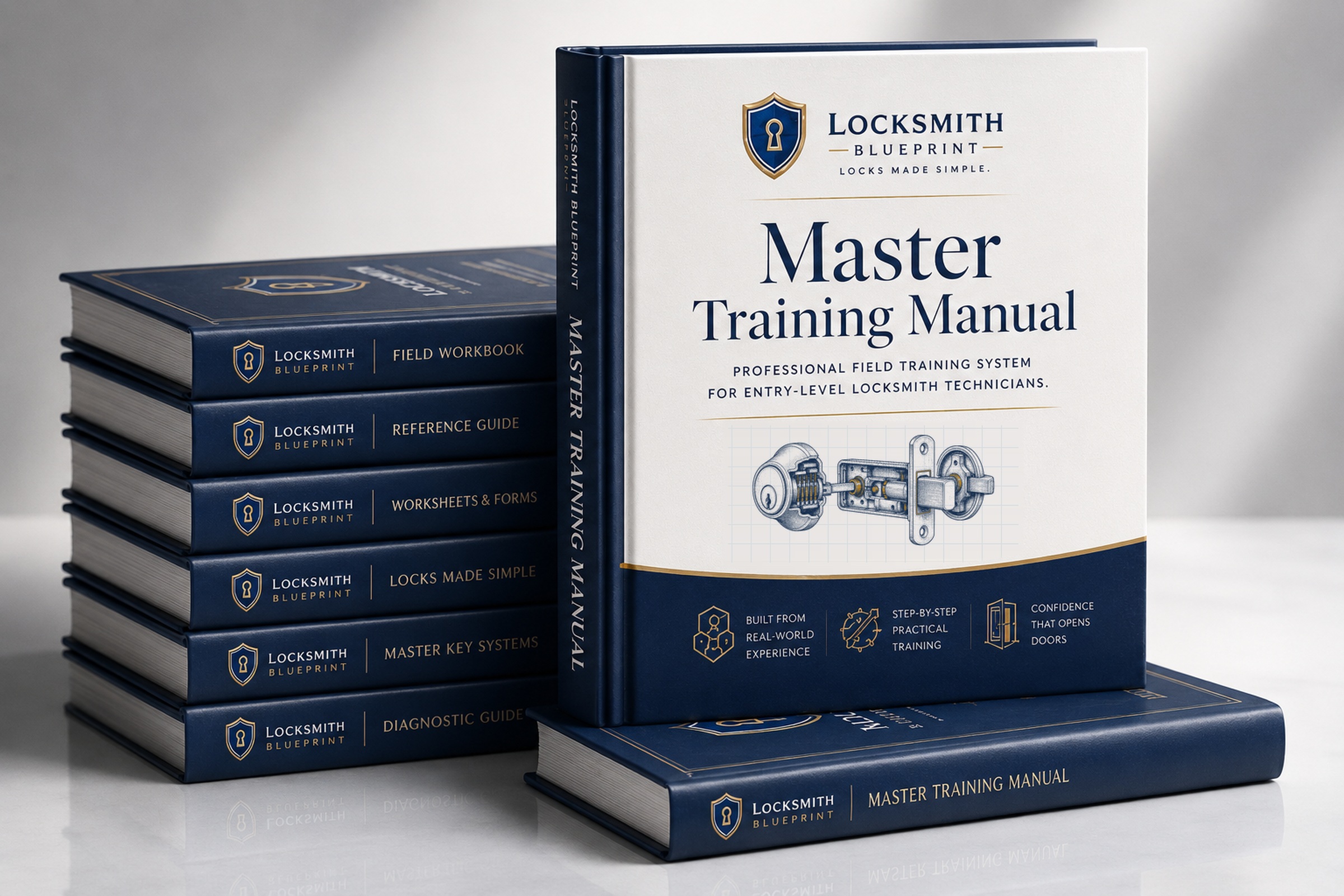
Turn the Alaska checklist into real mechanical skill
The Master Training Manual provides the connected written instruction, diagrams, checklists, and field reference that a short state guide cannot contain. It is training—not a government credential—and it should be paired with deliberate hands-on practice.
Verify Alaska at the source
These government sources support the statewide and specialty-scope statements used in this guide. They are starting points, not a substitute for a written agency answer about a specific job.
- Alaska professional licensing roster
- Alaska Business Licensing home
- Alaska business licensing FAQ
- New Alaska business-license workflow
- Business-license forms and fees
- Alaska business-license search
- Alaska construction-contractor FAQ
- Construction-contractor statutes and regulations
- Alaska electrical-administrator program
Save an evidence record
- Record the service names you searched.
- Save the agency URL and access date.
- Write down the agency or local contact.
- Keep any written classification with the estimate.
- Schedule a recheck before adding services.
What do locksmiths earn in Alaska?
Locksmiths and safe repairers (SOC 49-9094), wage-and-salary employees. Source: U.S. Bureau of Labor Statistics, OEWS, May 2025. Medians exclude self-employed business owners.
In Bill’s 10+ years in the trade, he personally knows locksmiths earning around $150,000 a year—typically established business owners with years of experience.
That is Bill’s firsthand observation, not a typical or promised result. What you earn depends on your market, skills, licensing, hours, pricing and business costs. Results vary. Watch Bill explain the numbers.
Choose the resource that matches your next step
These products support training and business planning. They do not replace Alaska licensing, permits, supervision, insurance, or official approval.
Foundation Edition
A guided starting point for beginners who want the trade, service categories, and learning sequence explained clearly.
Master Training Manual
The complete beginner-first technical training and field-reference system for structured locksmith study.
Operator Version
The business operating system for a trained reader preparing to organize real locksmith-company workflows.
Alaska locksmith requirements FAQ
Does Alaska require a statewide locksmith license?
No statewide locksmith-specific license identified. Verify the exact service and current official guidance before paid work.
Is a locksmith exam required in Alaska?
No confirmed locksmith exam. A separately regulated contractor, electrical, alarm, or security role can have its own qualification rules.
Do Alaska locksmiths need a background check or fingerprints?
Not identified for ordinary mechanical locksmith work; fingerprinting was also not identified for ordinary mechanical locksmith work. Employer, local, alarm, security, or specialty rules can differ.
Should a beginner get training before working in Alaska?
Yes. Even when no statewide locksmith-school mandate is identified, a beginner should learn mechanical fundamentals, practice on owned hardware, use customer-verification procedures, and seek supervised field feedback before solo paid work.
What should be verified locally in Alaska?
City, county, and scope-specific rules may apply even when no statewide locksmith credential is identified. Also verify zoning, home-business, permits, advertising, construction, fire, electrical, alarm, and access-control rules that match the location and complete job.
What is the safest first paid locksmith work in Alaska?
Choose a narrow mechanical service you can perform and test reliably, confirm customer authority, document the approved scope, and stop when the job reaches an unverified specialty or exceeds your current competence.
Operator Version$197 · digital download via Gumroad