 LOCKSMITH BLUEPRINTLOCKS MADE SIMPLE.
Locksmith School: How to Choose the Right Training Path in 2026
You do not need one specific kind of school to become a locksmith. You need a structured path that combines clear instruction, real hardware, deliberate practice, and responsible field experience.
Locksmith school can be useful, but it is only one route into the trade. Many beginners build stronger results by combining organized online learning, practice locks, coaching or apprenticeship, manufacturer information, and gradual field experience. The best choice is the one that teaches you to understand the hardware—not simply memorize a few procedures.
Do you actually need locksmith school?
A traditional in-person locksmith school can provide an instructor, scheduled practice, equipment, and classmates. That structure helps some learners. But a classroom is not the only place to develop real locksmith skill.
Locksmithing is a hands-on trade. Whichever training format you choose, you still need time with keys, cylinders, locks, doors, frames, tools, and realistic problems. A certificate of completion cannot replace the ability to identify hardware, diagnose a fault, complete work safely, and know when to stop.
Choose training by the quality of its sequence, practice, feedback, and field relevance—not by the word “school” alone. If you are still exploring the career, read How to Become a Locksmith before committing to a program.
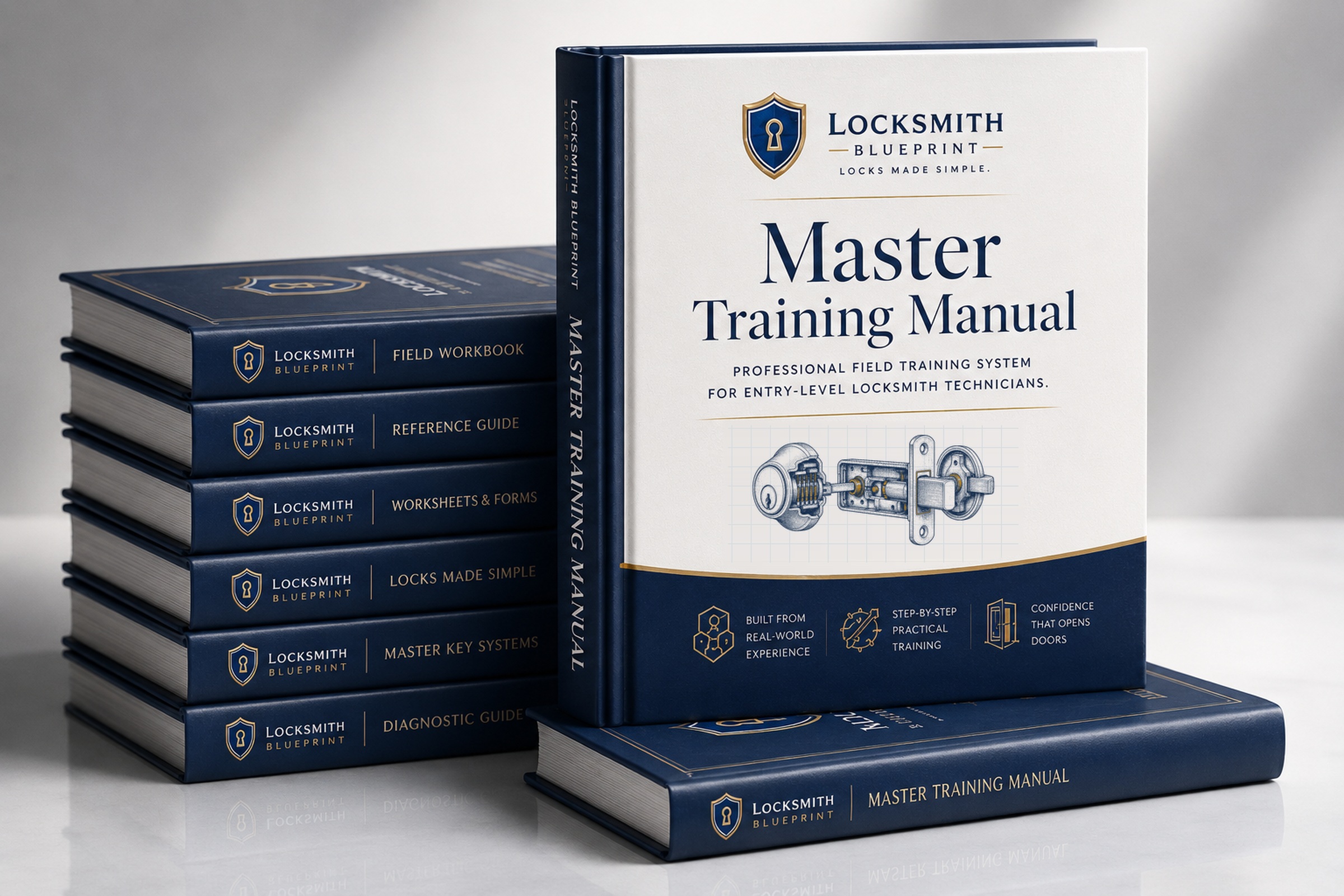
Turn scattered lessons into one structured training system.
The Master Training Manual connects mechanical foundations, tools, rekeying, hardware, diagnostics, field decisions, and professional reference material in a beginner-first sequence.
Five types of locksmith training
Most working locksmiths learn through more than one format. The question is not which option sounds impressive; it is which combination gives you clear fundamentals and enough responsible practice.
Flexible lessons can organize theory, terminology, demonstrations, and review. Pair them with real practice hardware.
Scheduled instruction and equipment access can help learners who benefit from direct supervision and a fixed pace.
Working beside an experienced locksmith adds real service-call context, customer interaction, and feedback.
Books, manuals, videos, and practice can work well when the material follows a deliberate sequence and uses reliable sources.
Structured study plus hands-on practice and supervised field exposure is the strongest route for many beginners.
What a real locksmith training path should teach
Good training gives you a connected mental model. Each lesson should help you identify the hardware, understand what changed, choose a safe next step, and test the result.
Keys, plugs, cylinders, pin stacks, shear lines, latches, bolts, doors, and frames.
Why rekeying works, how parts relate, how to test, and how to prevent common mistakes.
Key anatomy, blank and keyway comparison, wear, damage, and basic compatibility.
What each tool does, when it is appropriate, how to care for it, and what not to buy too early.
Symptoms, alignment, key wear, loose hardware, binding, damage, and evidence-based diagnosis.
Verify the customer and job, inspect the opening, document condition, communicate clearly, and know when to refer.
Start with work that matches your skill, tools, insurance, local rules, and available supervision.
Pricing context, records, customer expectations, licensing distinctions, and state or local requirements.
Locksmith certification versus licensing
Certification generally shows that a person completed training or demonstrated knowledge under a particular organization’s standards. It may help with credibility or employment, but it is not automatically government permission to perform locksmith work.
Licensing is a legal requirement imposed by a state or local government where applicable. Requirements can involve applications, background checks, insurance, business registration, testing, or other conditions. They vary by jurisdiction and can change.
What locksmith training costs—and how long it takes
There is no honest universal price or finish date. Your total depends on the format, equipment provided, depth of instruction, practice schedule, specialization, and local requirements.
| Training path | Cost pattern | Time pattern | What to verify |
|---|---|---|---|
| Online program | Usually lower overhead than an in-person program; tools and practice hardware may be separate. | Flexible and self-paced, but progress depends on consistent practice. | Lesson sequence, instructor experience, demonstrations, feedback, and hands-on assignments. |
| In-person school | Tuition may include workspace or equipment access; travel and schedule costs can add up. | Fixed dates create structure, but classroom completion is only the beginning of field development. | Shop time, class size, equipment access, curriculum depth, and what the credential actually represents. |
| Apprenticeship or employment | Arrangements vary; some positions pay while others combine observation and training. | Real exposure can accelerate judgment, but learning depends on the mentor and available job mix. | Legal employment terms, supervision, training scope, safety, and opportunities to practice progressively. |
| Self-directed or hybrid | You control spending on learning materials, practice locks, and tools. | Highly flexible; a written practice plan prevents drifting or skipping foundations. | Source quality, clear milestones, feedback, and a path into supervised real-world experience. |
A beginner can understand core concepts relatively quickly, but reliable professional judgment develops through repeated practice and real experience. Do not use a promised completion date as your only measure of training quality.
Before you enroll
A practical locksmith school comparison worksheet
Compare what you will actually do, what feedback you will receive, and what the complete path will cost. A course title or a completion certificate does not answer those questions.
Choose two programs or learning routes. Copy the six prompts below into your notes and record each provider’s written answer, the document or sample lesson that supports it, and anything still unknown. Use the same intended service goal for both comparisons: for example, learning mechanical residential hardware before considering specialist work.
1. What will I practice?
Ask for the sequence of lessons and a sample practical assignment. Does it move from identifying hardware to understanding the mechanism, controlled practice and testing? Record which locks, cylinders or door assemblies you will use and whether you supply them.
Record: practice tasks, hardware included, and the first skill you will be expected to demonstrate.
2. Who checks my work?
Ask how an instructor evaluates practical work, how you submit questions, and whether you can repeat an assignment after feedback. Distinguish access to recorded demonstrations from an actual review of your own work.
Record: feedback method, availability, and what happens when a learner makes a mistake.
3. What is the complete cost?
Request an itemized total rather than comparing tuition alone. Include required practice hardware, tools, consumables, travel, optional examinations and any recurring access charges. Read the provider’s current cancellation and refund terms before paying.
Record: tuition + required materials + travel + other required charges, with optional purchases listed separately.
4. What does completion prove?
Ask what must be demonstrated to finish, who issues the credential, and how its meaning can be checked. If you want a specific job, ask the prospective employer what training and practical evidence they value. Verify applicable official requirements independently through the licensing resources below.
Record: assessment method, credential issuer, and any independently verified requirement.
5. Does the schedule fit real practice?
Write down the study and bench-practice time you can sustain each week. Ask about equipment access, missed sessions, lesson access after completion and support when you fall behind. Finishing the videos and becoming consistent on hardware are separate milestones.
Record: your weekly schedule, practice location, and a realistic review point.
6. What comes after the course?
Ask how the program prepares you to identify unfamiliar work, communicate scope, test a completed job and seek help. If employment support is advertised, ask what that support includes rather than treating it as a job or income guarantee.
Record: supervised-experience options, referral boundaries, and your next learning step.
Turn the comparison into a decision
Mark each answer documented, unclear or not included. Do not turn unanswered questions into assumed benefits. A useful next action might be requesting a sample assignment, speaking to an instructor or narrowing your first service goal before purchasing training.
Keep your buying plan tied to the tools your current learning stage needs. Then use the first paid jobs readiness guide to separate completing a course from being ready to accept a customer’s job.
Watch a real career story, then evaluate your own path
In Dropped Out of Locksmith School… Still Built a 10,000+ Job Business, Bill shares his career experience. Treat this as one practitioner’s story, not a comparison of schools or a promise of your results. Use the worksheet above to evaluate the instruction and practice available to you.
Watch the career story on YouTube if the player does not load.
You can begin the free Beginner Locksmith Path while comparing options. Work through the fundamentals first; choose deeper paid training when its scope matches the gaps in your plan.
The best locksmith training path for most beginners
Start with a structured mechanical foundation, practice the same concepts on real hardware, then add supervised field exposure in stages. This keeps learning connected and helps you avoid buying advanced tools before you understand the work.
Verify the career and local requirements
Understand what locksmiths do, what your area regulates, and which services fit your intended path. Start with How to Become a Locksmith and the State Licensing Center.
Build the mechanical foundation
Learn the relationship between the key, keyway, plug, pins, shear line, latch or bolt, door, and frame. Follow the Beginner Locksmith Path in order.
Practice one skill family at a time
Use inexpensive practice hardware to repeat identification, disassembly, reassembly, rekeying concepts, alignment checks, and testing. Keep notes and correct mistakes before moving on.
Add feedback and field context
Seek an experienced locksmith, employer, instructor, or other qualified supervision. Learn customer communication, job verification, documentation, safe stop points, and the difference between a classroom exercise and a real opening.
Expand only after the fundamentals are reliable
Move into deeper residential, commercial, automotive, safe, or business topics according to your goals, local requirements, insurance, tools, and demonstrated competence.
Choose the product or resource that fits your next step
Free guides help you understand the path. Locksmith Blueprint products provide the connected structure, reference material, and implementation depth for serious study.
Foundation Edition — $39
For a new learner who wants an approachable entry into Locksmith Blueprint before moving into the complete manual.
Get the Foundation EditionMaster Training Manual — $97
A 307-page, beginner-first training and field-reference system with 39 chapters and 19 appendices.
View the Master Training ManualOperator Version — $197
For learners preparing to build and operate a locksmith company after establishing the technical and professional foundation.
Continue with these beginner locksmith lessons
Locksmith school and training questions
Do I need locksmith school?
No single school format is required everywhere. Many locksmiths learn through online instruction, hands-on practice, apprenticeships, employment, manufacturer education, and continuing field experience. You should still verify any licensing or training rules that apply where you plan to work.
Can I learn locksmithing online?
You can learn terminology, mechanical principles, hardware identification, demonstrations, and diagnostic thinking online. Because locksmithing is hands-on, online learning should be paired with real practice locks, appropriate tools, feedback, and supervised field experience.
How long does locksmith training take?
Core concepts can be learned relatively quickly, but reliable professional skill takes repeated hands-on practice and real experience. The timeline depends on your schedule, training quality, feedback, chosen specialties, and the range of jobs you encounter.
Do locksmiths need certification?
Certification and licensing are different. A certification may document education or knowledge under an organization’s standards, while a license is government permission where required. Employers and customers may value credentials, but you must verify the rules that apply to your location and work.
Do locksmiths need a license?
Requirements vary by state and locality and may change. Some jurisdictions regulate locksmith work directly, while others apply business, contractor, alarm, access-control, background-check, or local requirements. Verify current official rules before accepting paid work.
What tools do beginner locksmiths need?
Start with the tools required for the specific fundamentals you are practicing, such as common hand tools, practice locks, plug followers, pinning tools, tweezers, key gauges, and appropriate rekeying equipment. Avoid buying advanced equipment before you understand its purpose and your intended services.
Is an apprenticeship better than locksmith school?
An apprenticeship can add valuable field context and feedback, while a good school can provide organized instruction and scheduled practice. For many beginners, the strongest option is a hybrid: structured learning, deliberate practice, and supervised real-world experience.
What is the best locksmith training for beginners?
The best beginner training starts with how locks and keys work, then connects tools, rekeying, doors and hardware, common problems, professional job basics, local requirements, and supervised practice. Choose a program with a clear sequence instead of disconnected demonstrations.
Do not wait for the perfect school. Start with the right foundation.
Begin with the free Locksmith Blueprint path, practice the fundamentals on real hardware, and use the Master Training Manual when you are ready for one connected training and field-reference system.

Locksmith BlueprintLocks Made Simple
Real locksmith know-how from Bill, a working locksmith in Arizona: short videos, plain-English guides and printable checklists.